Show Me: Indulgence in the Age of Wellness
Consumers’ apparently contradictory desires to live healthily and indulge in instant pick-me-ups has created an opportunity for brands. In our latest Show Me, we unveil five new frontiers of healthy indulgence, highlight snack-stars of the future and discuss the role of design in hitting this lucrative sweet spot.

The Grazing Generation
It’s 1995 and a smiling Gary Lineker is practically skipping through the streets, charming the locals with his famous gentlemanly demeanour. He happens upon a small child who generously shares his bag of Walkers¹ (Lay’s to some readers).
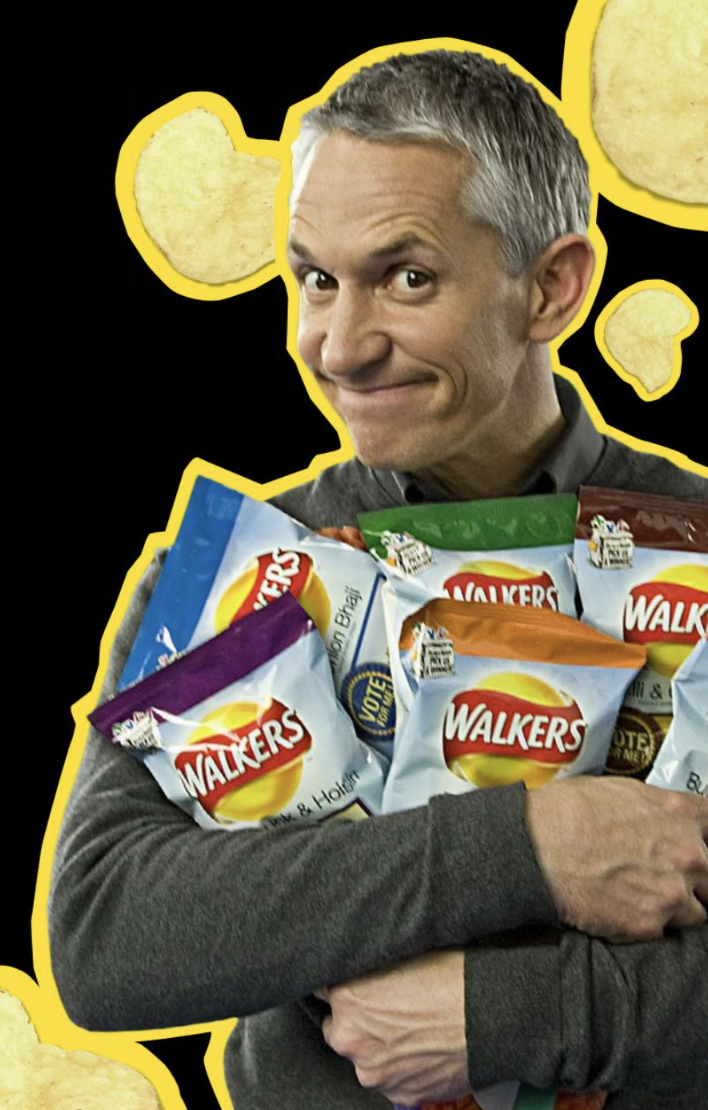
After tasting the crisps, Gary decides to pilfer the bag from the now distraught child, the gag being that even the nicest man in football would turn nasty to get his hands on the irresistible snack.
Evidence shows that snacking has a similar effect on us all, fundamentally shifting our entire way of eating.
Last year’s ‘Girl Dinner’ TikTok phenomenon (low-effort meals for one, constructed from traditional snack foods) is testament to just how significantly snacking is shaping our relationship to fuelling ourselves.
There’s more proof in the Gü pudding. Waitrose’s annual F&B report reveals that 30% of Brits have only two meals a day². Why spend time prepping, cooking and cleaning when a few bits can be assembled in no time?
Compounded with the global state of affairs, financial instability and the collective time-squeeze, for many a quick and readily available indulgence is a necessary coping mechanism.
But the temptation of pre-packaged, ultra-processed food-to-go can have a disastrous effect on our collective waistline — not the look and feel sought by today’s health- and image-conscious consumers.
So for each action, a reaction, and for every consumer anxiety, a growing movement of next generation convenience and snacking brands addressing the conflicting consumer needs to both indulge and feel healthy.
Let’s explore the macro and micro influences driving the growth of the ‘healthy indulgence’ market.
The Better For You Boom
If we were slowly moving towards more health-conscious food choices over the last few years, the pandemic really stepped on the gas.
More concerned about our wellbeing than ever before, nearly half of consumers say over the last two years they’ve looked into improving their diets and more than 60% say they’ve looked to reduce their sugar intake³. Health and fitness influencers soared to prominence, playing no small part in teaching the population about macronutrients, gut health and various dietary lexicons, both legitimate and questionable.
But the self-optimisation mindset extends beyond just food. Over a fifth of consumers are cutting back on alcohol consumption⁴, particularly younger generations, and 2022 saw the lowest number of people smoking cigarettes in the UK since records began⁵. We are also more informed than ever on how our choices affect the environment, with more and more people turning to either plant-based alternatives or fully vegan diets.
In 2023, as part of the annual Veganuary campaign, over 700,000 people pledged to go vegan, with 23,000 UK restaurants and grocers participating via Deliveroo⁶.
Sprinkle the new HFSS restrictions on top and you have the perfect recipe for a major cultural shift in how we want to treat ourselves.
Insane Grain

Next generation in more ways than one, Insane Grain comes with the promise of better gut health and the endorsement of football star Harry Kane, who has gone a step further than Gary, becoming an investor as well as ambassador.
Remixing Indulgence
Even in this new age of wellness, we can’t escape our desire for a little indulgence. There’s a new frontier now: finding a balance between tasty pleasure and beneficial nutrition.

With 56% of global consumers in 2022 saying they switched from traditional confectionery snacks to alternative high protein or low sugar options⁷, it’s a big opportunity, and brands are jumping on this new challenge. One in five new chocolate launches in the UK now have vegan or plant-based claims⁸.
There’s a plethora of ways to get involved in this better-for-you movement, with brands launching everything from high-protein chocolate bars to low-fat crisps. Whether it’s vegan ‘beef’ jerky, super low-calorie ice cream, or even peanut-free peanut butter, any dietary choice can be accommodated in this new world.
Healthy indulgence brands are rewriting the rules of how to communicate pleasure through design. Whether combining traditional cues with those that hint at the wellness benefits of their new products or creating entirely new codes, there’s no shortage of next generation brands entering the market.
We’ve identified the five new frontiers of wellness, and how the snack-stars of the future are balancing the promises of better for you and indulgence through design.
The Five New Frontiers of Wellness
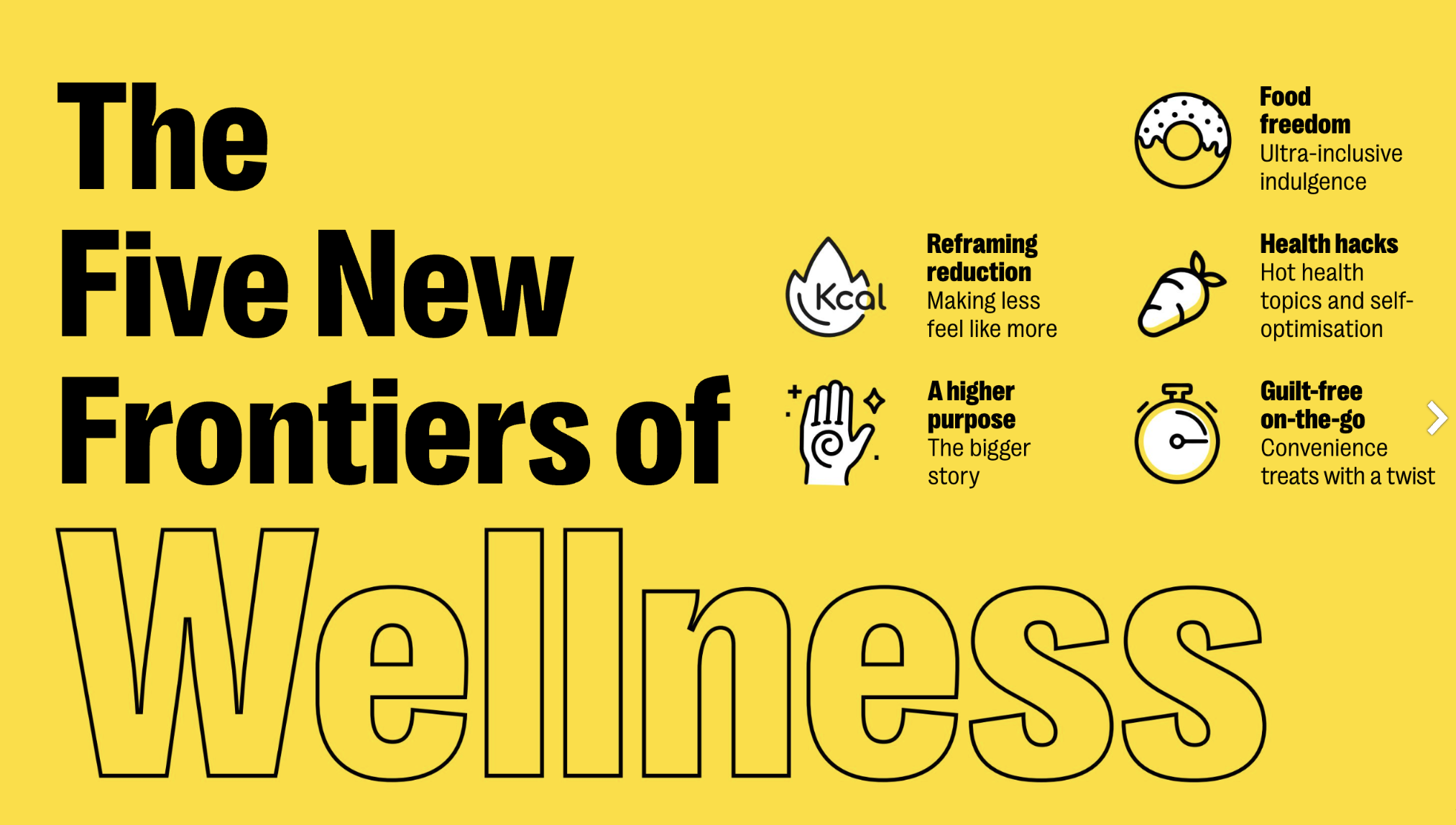
- Food freedom
Ultra-inclusive indulgence - Reframing reduction
Making less feel like more - A higher purpose
The bigger story - Health hacks
Hot health topics and self-optimisation - Guilt-free on-the-go
Convenience treats with a twist
Reframing Reduction

Dieting used to mean cutting out entire food groups. No sugar, no alcohol, no fat. No fun.
But making better dietary choices needn’t be sad plates of salad any more. Brands are engineering a myriad of ‘reduced-bad’ versions of classic treats, so consumers don’t ever have to go without again. Zero alcohol beers, low sugar ice cream and chocolate, baked crisps; whatever your vice is, it’s now ‘better’.
Self-described as the first ever ‘lifestyle’ ice cream, Halo Top revolutionised the low calorie snack category. Launched in 2012, Halo Top now sits in the top three brands for ice cream sales, alongside Häagen-Dazs and Ben & Jerry’s⁹.
Created for the lofty ideal of eating an entire tub of ice cream without guilt, Halo Top leans into indulgent consumption, boldly displaying the calories-per-tub and inviting the consumer to dig right into a variety of dessert-inspired flavours.
“There’s no pictograms of fruit in sight. Colour and texture as flavour cues help maintain a clear hierarchy”
— Sam Turton-Fox, Designer
The Design View

A game-changing distinctive asset
Using the calorie statement as the hero design asset allows them to really convey a single minded proposition – an ice cream you can eat by the tub, not the portion.
Clear design hierarchy
The huge variation in colours is kept in check with a super clear, cohesive and consistent brand hierarchy.
Category-defying flavour codes
There’s no cameos of fruit or pictograms. Colour and texture do all the work. In turn, it gives the pack more room to highlight brand vs. product.
Higher Purpose

More conscious of our food system’s effect on the planet than ever, alternative dietary choices are experiencing a boom in popularity with a quarter of people now identifying as ‘flexitarian’.
Brands are jumping on this trend, launching products that can be swapped easily for their animal-based alternatives. Think plant-based milks, vegan nuggets and the McPlant™.
Biff’s is a UK brand who are stewarding a third wave of veggie products in our supermarkets. After the Quorns & Lindas who made semi-realistic meat alternatives, came the Impossibles and Beyond Meats which fought to make hyper-realistic alternatives.
Biff’s proposition is meat alternatives for ‘people who actually like plants’. They dial up their natural and handmade quality, and challenge the slightly shadowy and energy-intensive ultra-processing required to create second wave meat products. Yet their design plays with the codes of streetfood and ‘dirty burgers’.
“The lexicon is fun, the tone is provocative, the bright unnatural colours, it’s nice and not worthy — there’s no heavy moral implications with the design”
— Stu Wood, Co-Founder
The Design View

Fast-food cues
The use of bright, unnatural colours and indulgent food photography play into the design codes of crave-worthy ultra-convenience foods.
Category stand-out
In amongst the other meat-alternatives, Biff’s breaks from the ‘hippie’ and worthy category norms, bringing fun and appealing to a much younger demographic.
Plants-first messaging
These packs call attention to the plant-based ingredients everywhere. From the ‘packed with plants’ tagline to the icons front and centre, this isn’t pretending to be anything else.
Food Freedom

Once upon a time, those with allergies simply had to hope for the best when eating out.
The gluten intolerant had to give up on bread, lest it be a sad, lumpy loaf. Those with nut allergies could never know the joy of Nutella.
Now a new day dawns and missing out can be a relic of the past. Coeliacs rejoicing over good gluten-free pizza crust is old news; today even those with nut allergies can eat ‘peanut’ butter. Brands are innovating like never before, it seems ‘now you can’ is a new way of life.
With a mission to reproduce the world’s favourite foods without engaging in the industries contributing to climate change or social injustice, Voyage Foods have the added benefit of largely avoiding the top nine allergens.
Using widely and efficiently grown crops and upcycled ingredients to formulate a totally different food is almost straight out of Star Trek, so the retro-futuristic, Jetsons-esque design tracks. Voyage is taking foods to infinity and beyond.
“This has a Newstalgia retrofuturism, it says ‘We’re taking you to the future, but it’ll be fun’”
— Paul Brennan, Co-founder

Health Hacks
It seems like every couple of years there’s a new hot topic in health and nutrition.
Fibre, protein, gut health, CBD, functional mushrooms — it’s an endless cycle of dietary optimisation.
Brands are either looking to jump on these trends, adapting and adding functional qualities to their products, or bring totally new products to the market. Their identities are fully wrapped up in their purpose.
Crafted to help consumers find calm in their everyday chaos, Trip drinks combine natural botanicals with a CBD infusion to provide proven relaxation benefits. Loved by trendsetters at Vogue and Dazed, a can of Trip has become an essential Gen Z accessory while transforming the CBD category and encouraging us to ‘drink smarter’.

Breaking from the cluttered and masculine category conventions at the time, Trip took design cues from youth-adored cult brands like Glossier to create a more approachable and cool product.
Trip cans are minimalistic, pastel-paletted and perfectly evocative of the chilled-out mood the drinks invoke.
“Regardless of the effect, the pack tells the drinker this is an act of self-care”
— Freyja Chase, Designer
The Design View
Pastel blocking
The pastel colour palette cuts through the noise of the soft drinks category. Its minimalism mimics the calmness of the product promise.
Brand before drink
With its subtle flavours, but super-identifiable can and Gen Z-heavy design cues, Trip is more of an accessory than a drink.
A watchout on icons
The keyline hand symbols on the cans are not totally successful — they have no real relation to the product and could be removed without any negative effects to the overall design.
Munch Against the Crunch

In this age of quick-fix indulgences that better our health and conscience, there’s convenience and then there’s ultra-convenience. Enter a whole new era of convenience foods.
Even macro-counting protein junkies can’t seem to let go of their sweet tooth. The internet is full of recipes for high-protein dupes of favourite treats, so it was only a matter of time until Mars Inc. joined the game. Launching ‘protein’ and ‘hi-protein’ versions of both Mars bars and Snickers bars, they are getting dual benefits. First, they are picking up health-conscious consumers who had turned away from classic chocolate bars, and by skirting around the HFSS rules, Mars and Snickers protein editions can be displayed at point of purchase.
With packs looking very similar to their non-protein counterparts, these bars are cuing all the indulgent memory pathways for a super-sweet treat.
“There’s a huge visual risk here, reliance on the masterbrand may not be enough to make consumers reconsider the category”
— Stu Wood, Co-Founder
The Design View

Masterbrand-led
As a spin-off from well-known brands, these bars have a heavy reliance on the brand equity of Snickers and Mars bars.
Hi-energy
Taking design cues from adjacent performance categories like energy drinks and protein powder, these bars lean quite masculine.
Big risks
With such a close relationship to their well-known sister products, have these bars done enough to drive differentiation and reconsideration?
In Conclusion...
Whilst some of these categories are breaking new ground and others are pioneering their third-wave and beyond, it’s clear that a collective momentum has built beyond faddy and into the future of indulgence food. As quickly as entrepreneurs are innovating, design moves hand-in-hand, creating, curating, and narrating the perceptions and experience of these products (and brands) for maximum contentment with minimal compromise.
Welcome to the next generation of wellness.
References
- The Hall of Advertising (1995) Walkers Crisps
Retrieved from: [YouTube link] - Waitrose Food & Drink Report (2023)
Retrieved from: [Waitrose link] - Sugar intake: FMCG Gurus (2022). Conscious indulgence: A health & wellness trend
Retrieved from: [fmcggurus.com link] - Alcohol consumption: NielsenIQ (2022). The sober curious movement is impacting what Americans are drinking
Retrieved from: [nielseniq.com link] - Smoking records: Office for National Statistics (2023). Adult smoking habits in Great Britain
Retrieved from: [ons.gov.uk link] - Veganuary: Veganuary, End of Campaign Report (2023) UK
Retrieved from: [veganuary.com link] - Low sugar: FMCG Gurus (2022). Conscious indulgence: A health & wellness trend
Retrieved from: [fmcggurus.com link] - Mintel (2022). The rise and rise of healthy indulgence in tough times: Food offers opportunity for delicious escapism
- Ben & Jerry’s: The Challenger Project (2018). Challenger brand to watch: Halo Top
Retrieved from: [thechallengerproject.com link]


Expert Insights To Help You Level Up Your Brand
Discover expert tips and insights to enhance your brand's presence.